


E-596
Antique Standard Talking Machine Model A Gramophone. United States, circa 1910
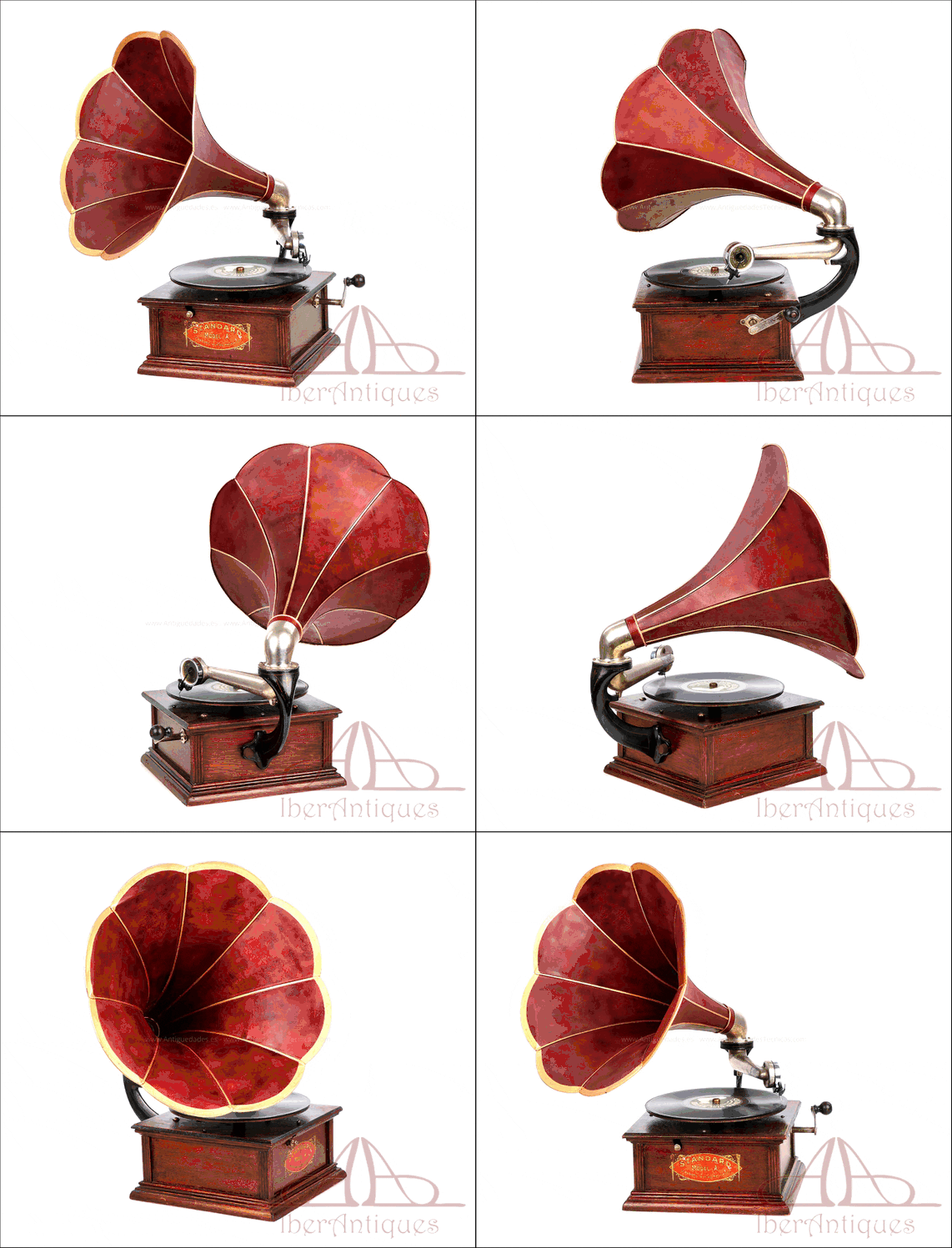
Antique Standard Model A gramophone, United States, circa 1910. Red and gold horn, original motor, and six Standard records. Restored and in good working condition.
Sold!
360º Photos. Click on the image to enlarge
Antique Standard Talking Machine Model A Gramophone. United States, circa 1910
Magnificent antique American Standard Talking Machine Model A, manufactured in the United States circa 1910. This attractive external-horn disc phonograph features an elegant oak cabinet and a striking red metal horn decorated with gold trim. Its beautiful design and unusual commercial history make it a particularly interesting piece for collectors of antique phonographs. The machine retains its main original period components, has been partially restored and is in perfect working order. It also comes with six original Standard records, specially manufactured for this type of machine.
The cabinet is made of oak and features solid construction with simple, well-proportioned lines. Its stepped base is decorated with attractive moldings that add elegance to the overall design. On the front, it retains its eye-catching original Standard Talking Machine Company label from Chicago, with its characteristic red and gold decoration. The wood has a warm, dark tone and a particularly appealing period appearance, preserving the natural signs of age that contribute to its authenticity and charm.
One of the most striking features of the machine is its Morning Glory-style metal horn, formed by large flared petals and finished in a rich red color with gold edging. This is the original period horn, carefully restored to recreate the characteristic red-and-gold finish of this model. Its elegant shape and beautiful combination of colors create a particularly appealing contrast with the oak cabinet.
The phonograph retains its original tonearm, with several patent inscriptions engraved into the metal, visible near the base of the horn. It is also fitted with its original Columbia reproducer, which has been completely rebuilt, with new rubber gaskets fitted and its nickel plating renewed. This explains its particularly bright appearance, although it is a genuine period component rather than a modern reproduction. Thanks to this restoration, the reproducer has regained its good acoustic performance and provides clear, pleasant sound reproduction.
The spring-driven motor is also original and remains in excellent working condition. It retains its period components and has sufficient power to play an entire record at a consistent speed. The original turntable also retains its original green felt covering, showing the stains and signs of wear accumulated over more than a century.
One of the most distinctive features of the Standard Model A is its oversized center spindle, which requires records with a correspondingly larger spindle hole. As a result, ordinary 78 rpm records cannot be played directly on this machine without modification or a suitable adapter. Instead, it was designed to use the proprietary records marketed by Standard. These records are less commonly encountered today and form an important part of the machine's historical and collectible appeal. This example comes with six original, compatible Standard records, including both single-sided and double-sided recordings. All six can be played on the phonograph, allowing its excellent working condition to be fully appreciated.
Its striking red and gold horn and elegant oak cabinet make this Standard Model A a highly decorative and desirable addition to any collection of antique musical machines. The preservation of its original motor, tonearm, reproducer and turntable felt gives collectors an authentic and historically appealing machine, with the necessary restoration work completed to allow it to be enjoyed and played today. The six included Standard records complete a wonderful opportunity to acquire a phonograph representing a particularly unusual chapter in the history of recorded music.
Measurements: Base width: 28 cm (11.02 in). Base depth: 28.5 cm (11.22 in). Cabinet height: 13.5 cm (5.31 in). Horn diameter: 42 cm (16.54 in). Horn length: 43 cm (16.93 in).
History of the Standard Talking Machine Company and the Model A:
The Standard Talking Machine Company was an American company based in Chicago that developed an unusual marketing system for phonographs and records during the early years of the 20th century. Its business began to gain importance around 1904-1905, thanks to a promotional strategy that allowed numerous retailers to offer phonographs at greatly reduced prices to customers who collected a specified number of coupons obtained through their purchases.
Standard did not manufacture its machines directly. The phonographs and recordings were supplied primarily by Columbia, one of the most important companies in the American phonograph industry. The Standard Model A, introduced around 1909, used Columbia mechanical components and was distinguished by its oak cabinet and characteristic red metal horn with gold detailing.
The key to Standard's business model lay in its proprietary records. Standard machines had a larger-than-conventional center spindle, which meant that their owners needed to purchase special records with a correspondingly larger center hole. These recordings originated from Columbia and were marketed in both single-sided and double-sided formats. In this way, subsequent record sales helped make the phonographs distributed through promotional offers commercially profitable.
The system became fairly widespread, and Standard developed commercial connections with similar brands, including Harmony and United, which also used special records. However, the lack of compatibility with conventional records eventually became a limitation as the recorded music market continued to expand.
Following the death of Robert Johns, one of the principal figures behind Standard, in 1915, the company was incorporated into the Consolidated Talking Machine Company in 1916. The latter continued selling existing stocks of machines and records for several years, until the Standard brand gradually disappeared from the market around 1918.
The Recording Featured in Our Video: "Red Wing," Frank C. Stanley and Henry Burr, 1907.
In our video, we play "Red Wing (An Indian Fable)," an American recording made in 1907 by baritone Frank C. Stanley and tenor Henry Burr, two prominent performers from the early years of recorded music. The record was issued on the Standard Disc Record label and features a recording originally made for Columbia, specially released for Standard phonographs, which required records with a larger center hole.
Composed by Kerry Mills, with lyrics by Thurland Chattaway, "Red Wing" was one of the major hits of American popular music in 1907. The song tells the sad story of a young Native American woman awaiting the return of her beloved, who has been killed in battle. Interestingly, its melody was inspired by a piano composition by the celebrated German composer Robert Schumann.
Frank C. Stanley (1868-1910) was a prominent figure in early commercial recording and a member of the famous Peerless Quartet. His fellow performer Henry Burr (1882-1941) would become one of the most popular and prolific tenors of the first half of the 20th century, participating in countless recordings for the leading American phonograph companies.
28 other products in the same category:
-

Antique Zonophone Gramophone...
-

Antique Cesar Vicente...
-

Antique Zonophone Gramophone...
-

Antique His Master's Voice...
-

Antique Spanish Gramophone...
-

Antique Chantal Gramophone...
-

Antique Phrynis 12 Trumpet...
-

Antique Pathéphone No.12...
-

Antique Columbia Gramophone...
-

Rare Antique Gramolina...
-

Antique French His Master's...
-

Antique G&T Monarch Senior...
-

Antique HMV Monarch V...
-

Antique HMV Monarch No. 5...
-

Antique HMV Monarch No. 13 C...
-

Antique HMV 101 His Master's...
-

Antique HMV 101 Burgundy Red...
-

Antique La Voz de su Amo HMV...
-

Antique Berliner Improved...
-

Vintage Berliner Style No. 2...
-

Antique Berliner Style No. 4...
-

Antique Extrafon (Extraphon)...
-

Antique Klingsor Gramophone...
-

Antique His Master's Voice...
-

Antique Ultraphon Tabletop...
-

Antique Zonofone Parlor Model...
-

Antique Columbia Grafonola...
-

Antique German Gramophone...


