


E-601
Antique HMV 101 His Master's Voice Suitcase Gramophone. Spain, circa 1930
Antique His Master's Voice HMV 101 suitcase gramophone, circa 1930. Iconic model, very well preserved, in excellent working condition and with superb sound quality.
Sold!
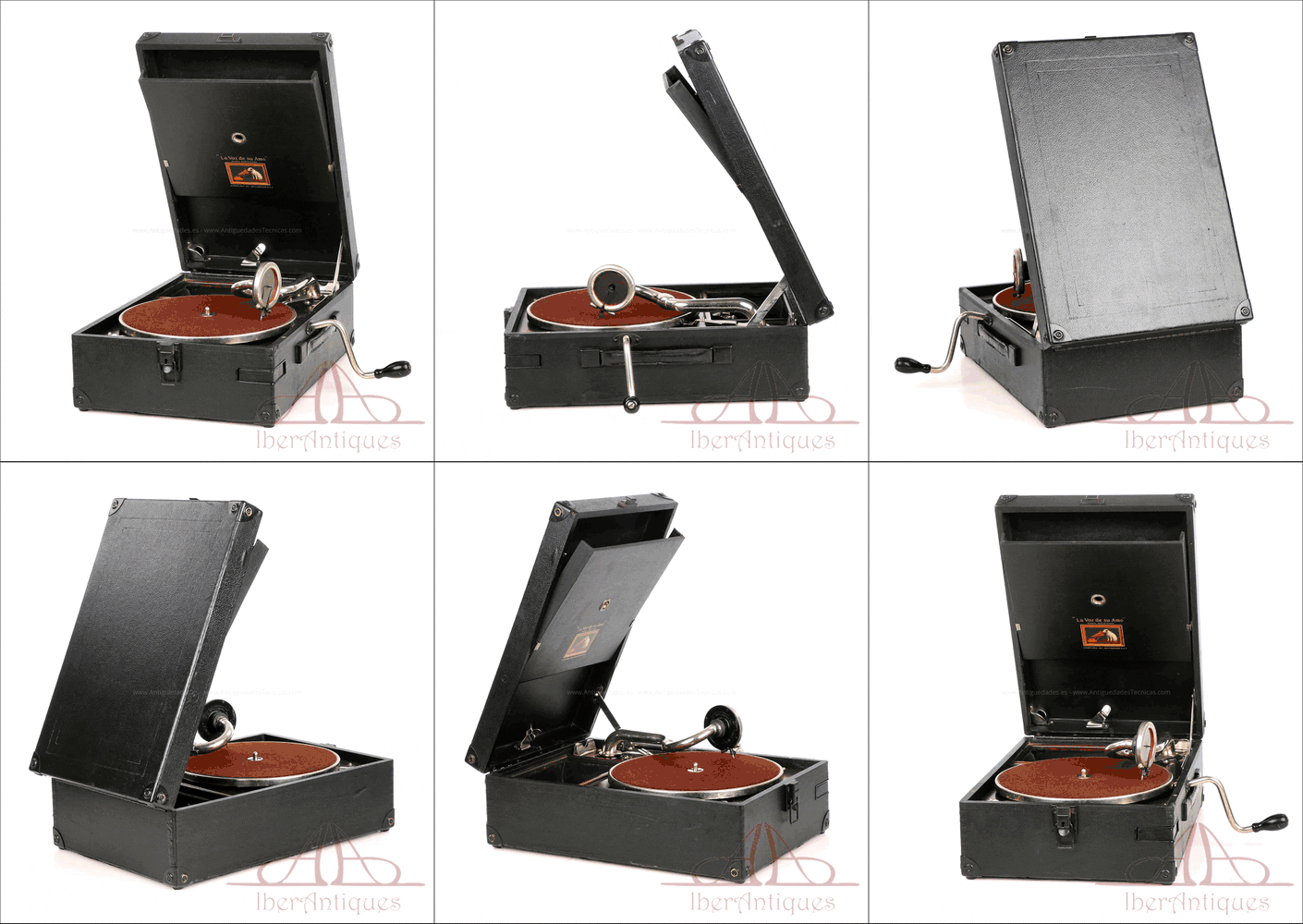
360º Photos. Click on the image to enlarge
Antique His Master's Voice (HMV) 101 Suitcase Gramophone. Spain, circa 1930
Magnificent antique portable La Voz de su Amo (His Master's Voice, HMV) Model 101 gramophone, dating from circa 1930. This is one of the best-known and most highly regarded portable gramophones produced by the historic brand, particularly famous for its outstanding sound quality. Housed in its classic black carrying case, this example is in very good condition and stands out for its perfect working order, exceptionally quiet motor, and powerful, clear, and pleasant sound reproduction. A beautiful machine that allows us to enjoy the music of another era with all the charm of an authentic mechanical phonograph nearly a century old.
The gramophone is housed in a sturdy rectangular carrying case covered in textured black material, with protective metal corner fittings, a front latch, and a side handle for easy transportation. Its compact design makes it convenient to store when not in use and easy to carry from one place to another. The exterior retains its attractive original appearance, with minor signs of age that do not detract from its good overall condition and preserve the character of an authentic period piece.
Opening the lid reveals a beautiful interior, with the motorboard finished in varnished wood of a warm mahogany tone, creating an attractive contrast with the black covering of the case. The turntable retains its brown felt covering and features an elegant metal rim. Particularly noteworthy is the gracefully curved metal tonearm, fitted with its original La Voz de su Amo No. 4 soundbox and connected to the internal acoustic amplification system characteristic of this model. Thanks to this ingenious design, the gramophone projects sound with surprising power without requiring a large external horn. The lid also incorporates a practical compartment for storing records and a dedicated space for the winding handle when the machine is closed.
Inside the lid, the gramophone retains its beautiful original La Voz de su Amo decal, featuring the famous image of Nipper the dog listening to a gramophone. It also preserves a small metal plaque from the firm Hijos de Guillermo Puig S. en C., located on Pelayo Street in Barcelona, one of the establishments that distributed these machines in Spain. Both details add special interest to the piece, preserving original features connected with the commercial history of this particular example.
The gramophone is equipped with a powerful spring-driven motor, wound using a side-mounted winding handle, whose operation is exceptionally quiet. It features a speed regulator and a convenient automatic start-and-stop mechanism. Playback begins when the tonearm is moved toward the far right, and when the needle reaches the inner portion of the record, the mechanism automatically stops the turntable. This ingenious system makes the machine particularly convenient to use, reflecting the quality of HMV engineering.
One of the greatest virtues of the HMV 101 is undoubtedly its magnificent acoustic performance. Despite its relatively compact dimensions, it delivers remarkably powerful and clear sound reproduction, with a warm, full, and pleasing sound. It is surprising to hear how a portable machine of this size can fill a room with music without electricity or modern amplification. This combination of excellent sound quality and easy portability helped make the HMV 101 one of the most popular and highly regarded portable gramophones of its time.
This example is in excellent working condition. Its motor runs smoothly and produces very little mechanical noise, allowing the recordings to be enjoyed without the disturbance sometimes caused by worn or poorly adjusted mechanisms. The tonearm, original No. 4 soundbox, turntable, metal fittings, and other visible components are all well preserved, retaining the attractive appearance of an original period gramophone. It is fully ready to play antique 78 rpm shellac records and enjoy their music with the distinctive sound of these historic machines.
The gramophone comes with several original 78 rpm shellac records, including "En qué quedamos" ("Where Do We Stand?"), performed by Raúl Abril and His Orchestra, which can be heard in the video accompanying our description. All the included records are compatible with the machine and can be played on it. New gramophone needles and a stroboscope for fine adjustment of the playback speed are also supplied. The new owner will therefore receive everything needed to begin enjoying music immediately, without having to look for additional accessories.
This beautiful La Voz de su Amo HMV 101 is an excellent choice for collectors and for anyone wishing to discover the charm of listening to antique records on an authentic gramophone. Its convenient portable format, quality construction, and excellent working condition make it easy and enjoyable to use, while its original details and history add considerable collectible interest. A wonderful machine to preserve and enjoy for many years, capable of bringing back the magic of early recordings and the special pleasure of listening to music just as our grandparents once did.
Measurements: Width of the closed case: 28.5 cm (11.22 in). Depth of the closed case: 41 cm (16.14 in). Height of the closed case: 14.5 cm (5.71 in).
History of the La Voz de su Amo HMV Model 101 Portable Gramophone:
The history of the HMV 101 portable gramophone began in October 1925, when the British Gramophone Company introduced a model designed to strengthen its position in the growing market for portable musical machines. Its predecessor, the Model 100, had appeared in June 1924 and used a simple acoustic reflector. The new HMV 101 incorporated a more advanced internal amplification system that considerably improved sound reproduction.
The design combined a compact carrying case, a turntable measuring approximately ten inches, a curved tonearm, and an HMV No. 4 soundbox on versions equipped with it. Its size made it convenient to transport, while its sound quality was truly surprising for a portable machine. These characteristics helped make it one of the company's greatest commercial successes.
During its years of production, the Model 101 underwent numerous technical modifications. The earliest examples had the winding handle at the front, while versions with a side-mounted handle appeared from 1927 onward. The motors, locking systems, needle compartments, and other construction details also evolved. These differences now make it possible to distinguish between different versions and establish approximate manufacturing dates.
In addition to the classic black finish, versions in different colors were marketed from 1927 onward, some featuring coverings that imitated crocodile skin. According to specialized literature, the black version had reached sales of 168,873 units by February 1931, a figure that demonstrates its enormous popularity.
The HMV 101 also reached the Spanish market under the La Voz de su Amo brand, associated with the Compañía del Gramófono, Sociedad Anónima Española. These machines were particularly appreciated for combining ease of transport, sturdy construction, and acoustic performance far superior to that of many other portable gramophones of the period.
Today, the HMV 101 remains one of the most highly regarded portable gramophones among enthusiasts of antique sound reproduction equipment. Its practical design, its importance in the history of recorded music, and especially its pleasing sound make it an excellent choice for enjoying original 78 rpm records.
The Recording Featured in Our Video: "En qué quedamos" ("Where Do We Stand?") - Raúl Abril and His Orchestra, circa 1946.
In our video, we play an original 78 rpm shellac record on this very HMV 101 gramophone, featuring the bolero "En qué quedamos" ("Where Do We Stand?"), performed by Raúl Abril and His Orchestra. The record was released in Spain on the Odeón label and manufactured in Barcelona by the Compañía del Gramófono-Odeón. Discographic documentation dates this edition to 1946, during the height of the popularity of boleros and large dance orchestras.
Raúl Abril (1911-1969), whose real name was José María Juncosa Panadés, was born in Porrera, Tarragona. Before pursuing music professionally, he worked as a schoolteacher, but the consequences of the Spanish Civil War interrupted his teaching career. After performing with various musical groups, he founded his own orchestra in 1943 and became one of the prominent voices of Spanish popular music during the 1940s. His elegant style and soft, pleasant voice found one of their most characteristic forms of expression in the bolero.
During those years, Raúl Abril recorded numerous songs that became very popular, including "Mi casita de papel" ("My Little Paper House"), "Siempre en mi corazón" ("Always in My Heart"), "Celos" ("Jealousy"), and "Las Ramblas de Barcelona" ("The Ramblas of Barcelona"). His career continued over the following decades, and he eventually became artistic director of the well-known Casablanca nightclub in Madrid. His records remain interesting historical documents of Spanish popular music from the mid-20th century.
28 other products in the same category:
-

Antique Zonophone Gramophone...
-

Antique Cesar Vicente...
-

Antique Zonophone Gramophone...
-

Antique His Master's Voice...
-

Antique Spanish Gramophone...
-

Antique Chantal Gramophone...
-

Antique Phrynis 12 Trumpet...
-

Antique Pathéphone No.12...
-

Antique Columbia Gramophone...
-

Rare Antique Gramolina...
-

Antique French His Master's...
-

Antique G&T Monarch Senior...
-

Antique HMV Monarch V...
-

Antique Standard Talking...
-

Antique HMV Monarch No. 5...
-

Antique HMV Monarch No. 13 C...
-

Antique HMV 101 Burgundy Red...
-

Antique La Voz de su Amo HMV...
-

Antique Berliner Improved...
-

Vintage Berliner Style No. 2...
-

Antique Berliner Style No. 4...
-

Antique Extrafon (Extraphon)...
-

Antique Klingsor Gramophone...
-

Antique His Master's Voice...
-

Antique Ultraphon Tabletop...
-

Antique Zonofone Parlor Model...
-

Antique Columbia Grafonola...
-

Antique German Gramophone...


