


E-602
Antique HMV 101 Burgundy Red Suitcase Gramophone. England, circa 1930
Antique red HMV 101 suitcase gramophone, England, circa 1930. Iconic model in very good condition, with a quiet motor and excellent sound quality.
Sold!
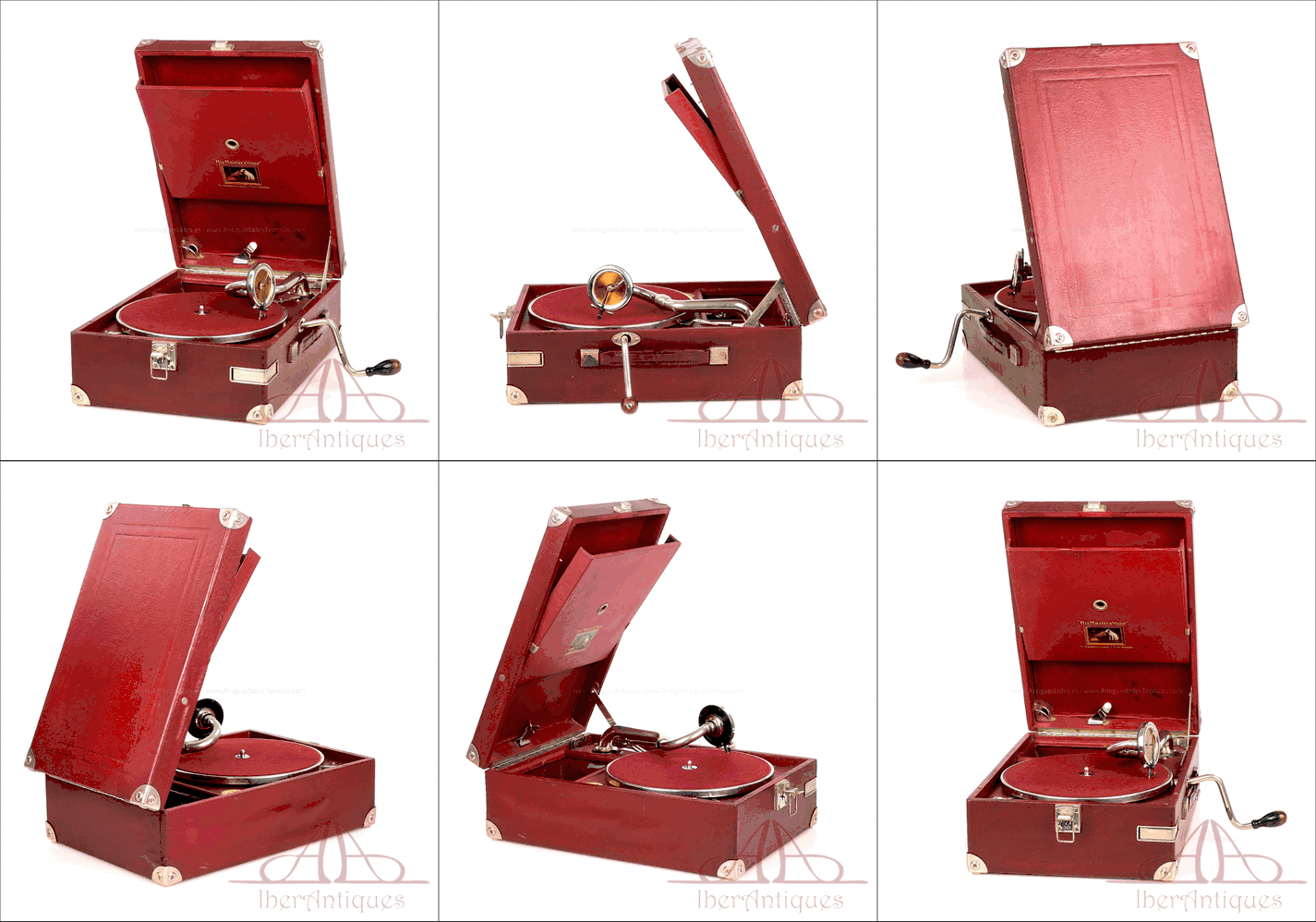
360º Photos. Click on the image to enlarge
Antique His Master's Voice HMV 101 Suitcase Gramophone. Red. England, circa 1930
Magnificent antique portable His Master's Voice (HMV) Model 101 gramophone, England, circa 1930. Presented in a beautiful burgundy red finish, this is one of the best-known and most highly regarded portable gramophones produced by the historic British company, particularly famous for its excellent sound quality. This example stands out for its attractive original period covering, its good state of preservation, and its perfect working condition, with an exceptionally quiet motor and powerful, clear, and pleasing sound. A beautiful machine that combines the charm of an authentic mechanical gramophone nearly a century old with a particularly elegant appearance that sets it apart from the traditional black models.
The gramophone is housed in a sturdy rectangular carrying case covered in original textured material in a beautiful shade of burgundy red. Its surface features a subtle leather-like texture and an elegant raised rectangular design on its main panels. Protective metal corner fittings, side reinforcements, a front latch, and a carrying handle complete a sturdy, compact, and highly attractive case. The covering retains its beautiful original appearance, with some signs of use and minor age-related wear that do not detract from its good overall condition and preserve the character of an authentic period piece.
Opening the lid reveals a beautiful interior, also finished in burgundy red, creating an elegant harmony with the exterior. The turntable retains its red felt covering and features an attractive metal rim. Particularly noteworthy is the gracefully curved silver-colored metal tonearm, fitted with its original La Voz de su Amo No. 4 soundbox and connected to the internal acoustic amplification system characteristic of the HMV 101. Thanks to this ingenious design, the gramophone produces a surprisingly powerful sound without requiring a large external horn. The lid also incorporates a practical compartment for storing records and a dedicated space for the winding handle when the machine is closed.
Inside the lid, the gramophone retains its beautiful original His Master's Voice decal, featuring the famous image of Nipper the dog listening to a gramophone. Beneath this illustration appears the inscription The Gramophone Company Ltd., Hayes, Middlesex, identifying the historic British company. The machine also retains its circular identification plate, clearly marked "Model 101" and bearing the identification number 1010046931, designated "Quote No." on the original plate. These original details add special interest to the piece and provide a direct connection to its manufacture and history.
The gramophone is equipped with a powerful spring-wound motor, operated by a side-mounted winding handle, which runs exceptionally smoothly and quietly. It features a speed regulator and an ingenious automatic start-and-stop mechanism with an automatic brake. Playback begins when the tonearm is moved to the far right, and when the needle reaches the inner portion of the record, the mechanism automatically stops the turntable. This practical system makes the machine particularly convenient to use and allows records to be enjoyed with greater ease, reflecting the quality of His Master's Voice engineering.
One of the greatest qualities of the HMV 101 is undoubtedly its magnificent acoustic performance. Despite its relatively compact dimensions, it delivers remarkably powerful and clear sound, with a warm, full, and pleasing tone. It is surprising to hear how a portable machine of this size can fill a room with music without electricity or modern amplification. Its exceptionally quiet motor also allows antique 78 rpm records to be enjoyed without noticeable interference from mechanical noise. This combination of excellent sound quality and easy portability helped make the HMV 101 one of the most popular portable gramophones of its time.
This example is in excellent working condition. Its motor runs smoothly and consistently, while the tonearm, original La Voz de su Amo No. 4 soundbox, turntable, and various mechanical components allow antique shellac records to be played properly. Its overall condition is very good, retaining the attractive appearance of an original period gramophone. The covering shows some minor scuffs and wear, particularly around certain edges and the carrying handle. Some dark marks are also visible inside the lid, along with normal signs of age. These details are consistent with its age, do not affect its excellent operation, and form part of the history of a machine that has survived to the present day while retaining its authenticity.
The beautiful burgundy red finish is one of the main attractions of this HMV 101. Compared with the more familiar black versions, models produced in different colors offer a particularly striking and elegant appearance. In this example, the exterior covering, interior, and turntable felt create a beautifully coordinated ensemble, enhanced by the metal fittings and silver-colored tonearm. Its portable design also makes the phonograph convenient to store when not in use and easy to carry from one place to another.
The gramophone comes with several original 78 rpm shellac records, including "No vuelvo contigo" ("I'm Not Coming Back to You"), performed by Antonio Machín and His Ensemble, which can be heard in our video. All the included records are compatible with the machine and can be played on it. New gramophone needles and a stroboscope for fine adjustment of the playback speed are also supplied. The new owner will therefore receive everything needed to begin enjoying music immediately, without having to look for additional accessories.
This beautiful burgundy red His Master's Voice HMV 101 is an excellent choice for collectors and for anyone wishing to discover the charm of listening to antique records on an authentic gramophone. Its attractive colored finish, quality construction, and excellent working condition make it a particularly appealing piece, capable of standing out in any collection while offering the pleasure of regular use. A wonderful machine to preserve and enjoy for many years, bringing back the magic of early recordings and allowing us to experience music with the distinctive sound enjoyed by earlier generations.
Measurements: Width of the closed case: 28.5 cm (11.22 in). Depth of the closed case: 41 cm (16.14 in). Height of the closed case: 14.5 cm (5.71 in).
History of the His Master's Voice HMV Model 101 Portable Gramophone:
The history of the His Master's Voice Model 101 portable gramophone began in October 1925, when the British Gramophone Company introduced a new machine designed to strengthen its position in the growing market for portable gramophones. Its predecessor, the Model 100, had appeared in June 1924 and used a simple acoustic reflector. The new HMV 101 incorporated a more advanced internal acoustic amplification system that considerably improved both the quality and volume of the sound.
Its design combined the main advantages of a household gramophone in a compact, easily transportable carrying case. It featured a turntable measuring approximately ten inches, an elegant curved tonearm, and an HMV No. 4 soundbox on versions equipped with it. Its sound quality, together with the convenience of transportation and operation, helped make it one of the company's most popular models.
Throughout its production years, the HMV 101 underwent numerous technical and structural modifications. The earliest examples had the winding handle at the front, while versions with a side-mounted handle appeared from 1927 onward. The motors, locking systems, needle compartments, and various mechanical components also evolved. These differences now make it possible to distinguish successive versions of the model and establish approximate manufacturing dates for surviving examples.
One of the most interesting chapters in its history was the introduction, beginning in 1927, of special versions in different colors, intended for buyers looking for machines that were more striking and elegant than traditional black gramophones. These finishes included attractive shades of red, blue, and other colors, as well as luxury versions with decorative coverings, some featuring textures that imitated crocodile skin. These finishes gave the machines a more refined appearance and allowed owners to choose a gramophone that suited their personal taste.
The model's commercial success was extraordinary. According to specialized literature, sales of the black version alone had reached 168,873 units by February 1931, a figure that demonstrates the enormous popularity of the HMV 101. Its sturdy construction, continuous technical improvements, and especially its excellent acoustic performance explain why it was so warmly received by people who wanted to enjoy their favorite records away from the traditional living room.
Today, the HMV 101 remains one of the most highly regarded portable gramophones among enthusiasts of antique gramophones and mechanical sound reproduction. Its practical design, its importance in the history of recorded sound, and its pleasing acoustic performance continue to make it an excellent choice for enjoying original 78 rpm records. Versions in colors other than black, such as this attractive burgundy red example, also offer special aesthetic appeal and provide an interesting illustration of the variety of finishes marketed by His Master's Voice during those years.
The Recording Featured in Our Video: "No vuelvo contigo" ("I'm Not Coming Back to You") - Antonio Machín and His Ensemble, 1946.
In our video, we play an original 78 rpm shellac record on this very HMV 101 gramophone, featuring the bolero "No vuelvo contigo" ("I'm Not Coming Back to You"), performed by Antonio Machín and His Ensemble. The recording was made in 1946 and released in Spain on the Odeón label, with the record manufactured in Barcelona by the Compañía del Gramófono-Odeón. This performance belongs to a particularly important period in Machín's career, when the singer was beginning to establish himself as one of the great voices of the bolero in Spain.
The song was composed by Cuban musician Mario Fernández Porta (1917-1996), one of the notable Latin American bolero composers of the mid-20th century. Its sheet music was published in Barcelona in 1945, one year before the Antonio Machín recording heard in our video. Fernández Porta enjoyed an extensive career as a composer and pianist, creating songs such as "Mentiras tuyas" ("Your Lies"), "Realidad" ("Reality"), and "No vuelvo contigo" ("I'm Not Coming Back to You"), which became widely known through performances by prominent singers of the period. His compositions are characterized by sentimental melodies and the romantic expressiveness typical of the Cuban bolero.
Antonio Machín (1903-1977) was born in Sagua la Grande, Cuba, and became one of the most beloved singers in Spanish popular music. After developing his career in Cuba, the United States, and France, he settled in Spain in 1939. During the 1940s, he achieved enormous popularity thanks to his warm voice, elegant style, and interpretations of romantic boleros. In 1946, he recorded several songs that would contribute significantly to his success, including "No vuelvo contigo" ("I'm Not Coming Back to You"), "Toda una vida" ("A Whole Lifetime"), and "Amar y vivir" ("To Love and to Live"). His career continued over the following decades, and he became an unforgettable figure in romantic popular music, bringing songs such as "Dos gardenias" ("Two Gardenias"), "Angelitos negros" ("Little Black Angels"), and "El manisero" ("The Peanut Vendor") to a wide audience. His records remain valuable historical documents of Spanish popular music from the mid-20th century.
28 other products in the same category:
-

Antique Zonophone Gramophone...
-

Antique Cesar Vicente...
-

Antique Zonophone Gramophone...
-

Antique His Master's Voice...
-

Antique Spanish Gramophone...
-

Antique Chantal Gramophone...
-

Antique Phrynis 12 Trumpet...
-

Antique Pathéphone No.12...
-

Antique Columbia Gramophone...
-

Rare Antique Gramolina...
-

Antique French His Master's...
-

Antique G&T Monarch Senior...
-

Antique HMV Monarch V...
-

Antique Standard Talking...
-

Antique HMV Monarch No. 5...
-

Antique HMV Monarch No. 13 C...
-

Antique HMV 101 His Master's...
-

Antique La Voz de su Amo HMV...
-

Antique Berliner Improved...
-

Vintage Berliner Style No. 2...
-

Antique Berliner Style No. 4...
-

Antique Extrafon (Extraphon)...
-

Antique Klingsor Gramophone...
-

Antique His Master's Voice...
-

Antique Ultraphon Tabletop...
-

Antique Zonofone Parlor Model...
-

Antique Columbia Grafonola...
-

Antique German Gramophone...


