


E-603
Antique La Voz de su Amo HMV 109 Tabletop Gramophone. Spain, circa 1928
Antique La Voz de su Amo HMV 109 gramophone, featuring an elegant mahogany cabinet, original No. 4 soundbox, and excellent working condition. Spain, circa 1928.
Sold!
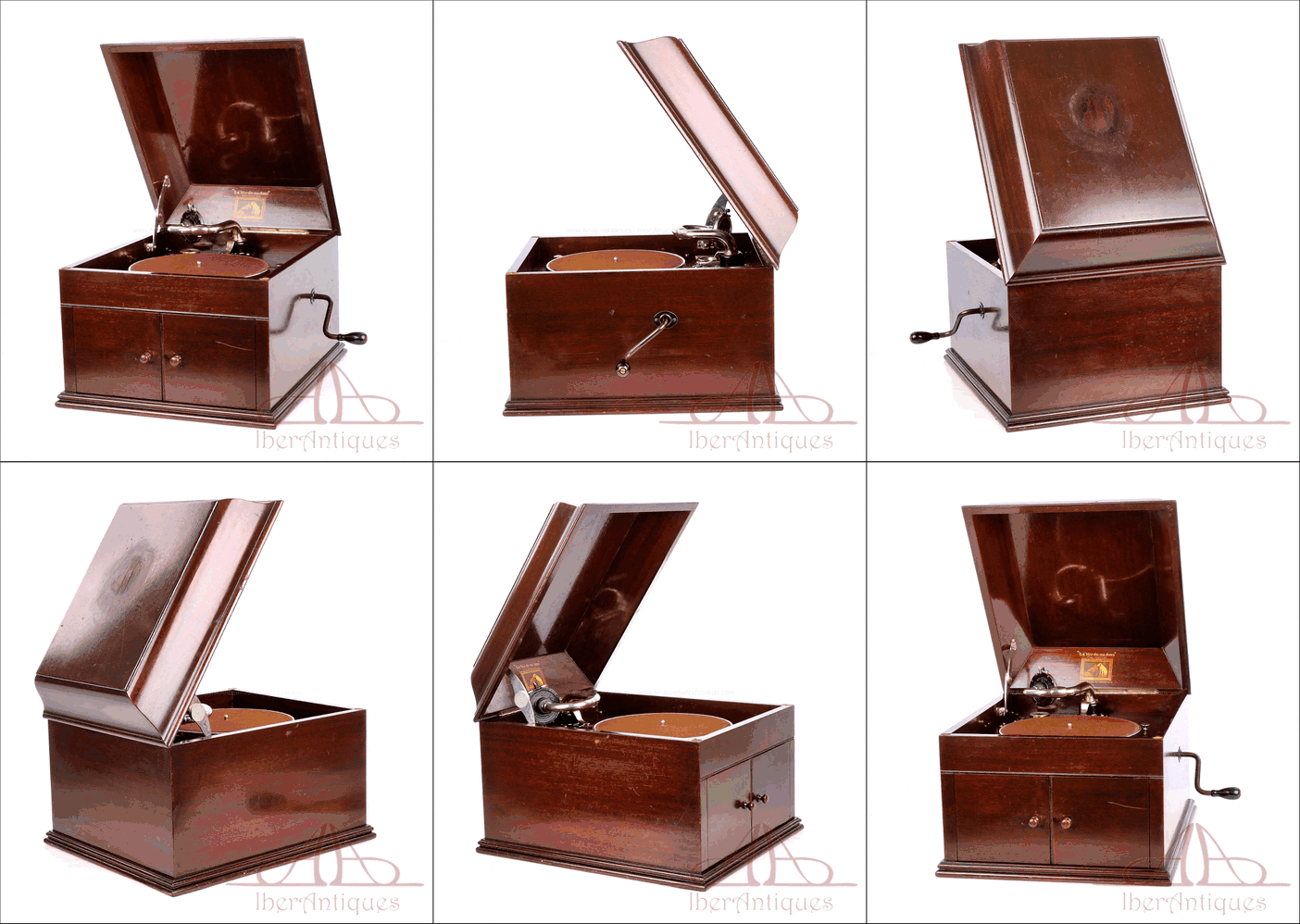
360º Photos. Click on the image to enlarge
Antique La Voz de su Amo HMV 109 Mahogany Gramophone. Spain, circa 1928
Magnificent antique tabletop La Voz de su Amo (His Master's Voice, HMV) Model 109 gramophone, made in Spain from mahogany for the Spanish market, circa 1928. Its elegant cabinet, with its warm reddish tones, solid construction, and excellent mechanical operation, makes this model a beautiful example of late-1920s home gramophones, when listening to music at home was a special experience. It retains its main original components and allows you to fully enjoy antique shellac records.
The gramophone is housed in a sturdy mahogany cabinet with a beautiful reddish-brown finish that enhances the natural grain of the wood. Its design features clean, balanced lines, carefully crafted moldings, and a distinctive raised-profile lid. Two doors on the front open and close to expose or conceal the outlet of the internal acoustic horn. Besides adding elegance to the cabinet, these doors provide a simple way to adjust the volume by opening or closing them according to the listener's preference.
Lifting the lid reveals the playback mechanism, with its turntable covered in brown felt. Particularly attractive is the beautifully curved metal tonearm, fitted with its original His Master's Voice No. 4 soundbox. Sound travels through an acoustic horn housed inside the cabinet and is projected through the front opening, without electricity or the need for a large external horn. The horizontal wooden partitions visible behind the open front doors form part of this distinctive acoustic outlet and complete the attractive design of the cabinet.
The gramophone retains its beautiful original La Voz de su Amo decal, featuring the famous image of Nipper the dog and the inscription of the Compañía del Gramófono, Sociedad Anónima Española. It also retains a retailer's plaque from Hijo de Guillermo Puig S. en C., of Barcelona, giving its address on Pelayo Street and a branch on Ronda de San Pablo. These original markings reinforce the authenticity of the gramophone and provide an interesting insight into its commercial history in Spain.
The gramophone is in excellent mechanical working condition. Its spring-wound motor, operated by a side-mounted winding crank, runs smoothly and consistently. The speed regulator, tonearm, original No. 4 soundbox, and automatic brake mechanism all operate correctly. As is typical of these historic mechanisms, activation of the automatic brake may depend on the characteristics of the run-out groove at the end of each record. It produces a powerful, clear, and pleasing sound, as can be heard directly in the demonstration video accompanying this description.
Its cosmetic condition is good, although the wood shows some scuffs, small chips, and localized areas of wear. The upper lid has a visible circular mark that has affected the varnish, probably caused by an object that remained resting on its surface for an extended period. Its exact origin cannot be determined with certainty. These imperfections are purely cosmetic and do not affect the excellent operation of the gramophone.
The gramophone comes with several original 78 rpm shellac records compatible with the machine, including the Columbia record "Quiero llevarme tu amor" ("I Want to Take Your Love with Me"), performed by Jorge Sepúlveda with Tejada y su Gran Orquesta (Tejada and His Grand Orchestra) in 1944, which we play in our video. New gramophone needles and a stroboscope for fine adjustment of the playback speed are also included. The new owner will have everything needed to start enjoying antique records right away.
Its elegant mahogany cabinet, with its warm reddish color, makes this gramophone a particularly attractive addition to a living room, library, or collection of antique gramophones. But its real charm lies in the fact that it still works perfectly. Simply place a period record on the turntable and operate the mechanism to hear music as it was enjoyed almost a century ago. A magnificent collector's piece combining beauty, history, and the pleasure of owning a fully functional antique Spanish phonograph.
Measurements: Cabinet width: 39.5 cm (15.55 in). Cabinet depth: 45.5 cm (17.91 in). Height with the lid closed: 32.5 cm (12.80 in).
History of La Voz de su Amo and the HMV Model 109 Gramophone:
The His Master's Voice Model 109 gramophone was introduced by the British company The Gramophone Company in October 1925 as an evolution of the earlier Model 108. Designed as a tabletop gramophone for domestic use, it incorporated an internal acoustic amplification system capable of producing powerful, clear sound without requiring a large external horn. It was equipped with an HMV No. 32 mechanical motor, a curved tonearm, and the renowned His Master's Voice No. 4 soundbox.
Various design improvements were introduced during its production, particularly to the lid support systems and braking mechanisms. In September 1926, the No. 2 automatic brake was introduced, and from 1928 onward, versions equipped with the No. 3 system began to appear. The model was marketed in oak and mahogany cabinets, the latter being an elegant variation distinguished by its warm reddish tones.
The HMV 109 enjoyed considerable commercial success. According to specialized reference literature, until the introduction of Models 104 and 130 in July 1929, monthly sales rarely fell below one thousand units. By the time the model was discontinued in June 1930, a total of 35,818 oak examples and 14,035 mahogany examples had been sold, figures that demonstrate the model's widespread popularity.
In Spain, the La Voz de su Amo brand was closely associated with the Compañía del Gramófono, Sociedad Anónima Española, and with Barcelona, one of the principal centers of the Spanish recording industry. The company developed the production and marketing of gramophones and records intended for the Spanish market. The example offered here belongs to this Spanish production and retains its original decal and a plaque from the retailer Hijo de Guillermo Puig S. en C., both important reminders of its commercial history.
Today, the HMV 109 is appreciated for its solid construction, elegant design, and excellent acoustic reproduction. This Spanish mahogany example, dating to circa 1928, continues to offer the pleasure of playing original 78 rpm records using an entirely acoustic mechanism.
The recording featured in our video: "Quiero llevarme tu amor" - Jorge Sepúlveda with Tejada y su Gran Orquesta, 1944.
In our video, we play an original 78 rpm shellac record on this very La Voz de su Amo HMV 109 gramophone. Manufactured in Spain and released on the Columbia label, the record contains the foxtrot "Quiero llevarme tu amor" ("I Want to Take Your Love with Me"), performed by Jorge Sepúlveda with Tejada y su Gran Orquesta. This recording, made in 1944, is of particular historical interest because it is among Jorge Sepúlveda's earliest commercial recordings. The composition was written by Julio Merino and reflects the popularity achieved in Spain by American-influenced dance rhythms during the 1940s.
This recording was made during the early stages of Jorge Sepúlveda's recording career, when the singer met Maestro Tejada, Columbia's artistic director, who offered him a recording contract. In 1944, he recorded two of his earliest songs, "Adiós" ("Goodbye") and "Quiero llevarme tu amor" ("I Want to Take Your Love with Me"), which were released together on a Columbia record. The performance preserves the characteristic style of the great Spanish dance orchestras of those years, with elegant instrumentation and a prominent vocal performance by a singer who would soon achieve extraordinary popularity.
Jorge Sepúlveda (1917-1983), the stage name of Luis Sancho Monleón, was born in Valencia and became one of Spain's most popular singers of boleros and popular music during the 1940s and 1950s. After beginning his artistic career performing tangos and rancheras, he appeared in Zaragoza in 1941 and later moved to Madrid, where he began his solo career. His warm, melodic voice, heard especially through radio broadcasts, made him one of the favorite performers of Spanish audiences. Among his best-known songs are "Mirando al mar" ("Looking Out to Sea"), "Santander", "A escondidas" ("In Secret"), and "Tres veces guapa" ("Three Times Beautiful"). He died in Palma de Mallorca in 1983, leaving behind an extensive discography that remains a valuable record of twentieth-century Spanish popular music.
28 other products in the same category:
-

Antique Zonophone Gramophone...
-

Antique Cesar Vicente...
-

Antique Zonophone Gramophone...
-

Antique His Master's Voice...
-

Antique Spanish Gramophone...
-

Antique Chantal Gramophone...
-

Antique Phrynis 12 Trumpet...
-

Antique Pathéphone No.12...
-

Antique Columbia Gramophone...
-

Rare Antique Gramolina...
-

Antique French His Master's...
-

Antique G&T Monarch Senior...
-

Antique HMV Monarch V...
-

Antique Standard Talking...
-

Antique HMV Monarch No. 5...
-

Antique HMV Monarch No. 13 C...
-

Antique HMV 101 His Master's...
-

Antique HMV 101 Burgundy Red...
-

Antique Berliner Improved...
-

Vintage Berliner Style No. 2...
-

Antique Berliner Style No. 4...
-

Antique Extrafon (Extraphon)...
-

Antique Klingsor Gramophone...
-

Antique His Master's Voice...
-

Antique Ultraphon Tabletop...
-

Antique Zonofone Parlor Model...
-

Antique Columbia Grafonola...
-

Antique German Gramophone...


