


E-641
Antique Columbia Grafonola No. 100 Cadet Gramophone. England, circa 1930
Columbia Viva-tonal No. 100 portable gramophone, circa 1930. Red and black metal case, original components, and excellent working condition. England.
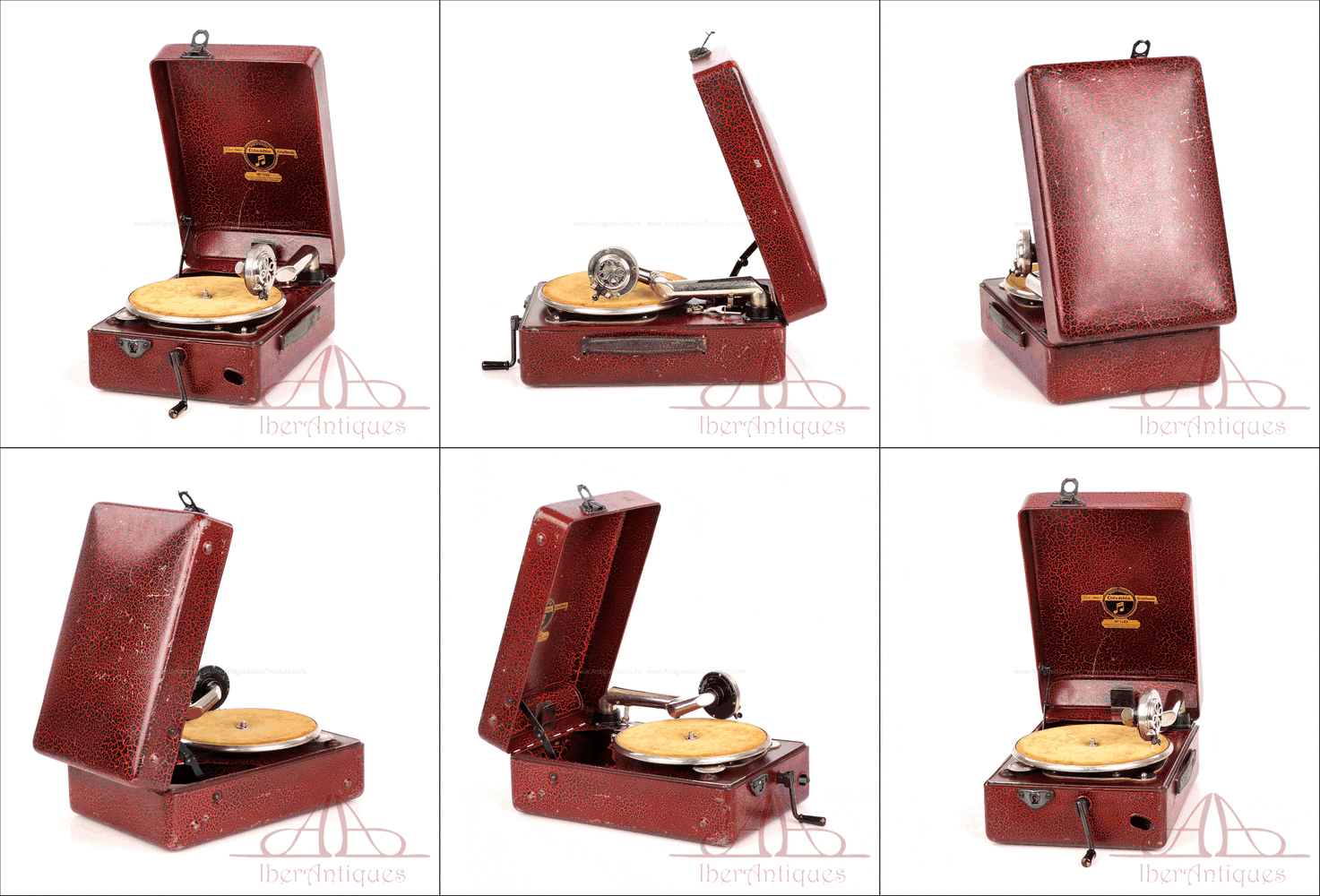
360º Photos. Click on the image to enlarge
Antique Columbia Viva-tonal No. 100 Portable Gramophone. England, circa 1930
Antique Columbia Viva-tonal Grafonola portable gramophone, Model No. 100, also known as the "Cadet", manufactured in England around 1930. A charming, compact gramophone distinguished by its all-metal case and original red and black crackle finish. It retains all its original components, including the Columbia No. 15B soundbox and the distinctive Plano-Reflex tonearm. It is in good overall condition and works perfectly, offering the opportunity to continue enjoying music on a machine that is now approaching one hundred years of age.
One of its most distinctive features is its small rectangular case, made entirely of metal, including both the base and the lid. It has an eye-catching red finish with a fine black crackle pattern, a combination that gives it a very distinctive appearance and sets it apart from the portable gramophones covered in fabric or faux leather that were common at the time. Its ingenious construction accommodates the turntable, tonearm, soundbox, and operating mechanisms within a remarkably small space. It features a side-mounted carrying handle, a front metal latch, and a lid support mechanism for convenient use. When closed, the gramophone forms a small, sturdy carrying case that is easy to transport and store.
Inside the lid, it retains its original manufacturer's label, featuring the Columbia emblem in black and gold and the inscriptions "Viva-tonal", "Columbia", "Grafonola", "Made in England", and "No. 100". The label also includes references to the patents protecting its manufacture in Great Britain and other countries. This label allows the model to be identified precisely and confirms its English origin. The red and black finish continues inside the case, creating a very pleasing appearance when the gramophone is open.
The machine is fitted with the distinctive Columbia Plano-Reflex tonearm, recognizable by its unusual angular design and silver-colored metal finish. Developed in the late 1920s, this system was designed to improve sound transmission and amplification in portable gramophones. Its construction channels the acoustic vibrations into the interior of the case, making efficient use of the available space without requiring an external horn. In addition to its technical interest, the Plano-Reflex tonearm is one of the most recognizable visual features of this model.
Particularly noteworthy is its original Columbia No. 15B soundbox, which retains its metal construction and attractive decorative front grille. This is the correct soundbox for the model, designed to provide good reproduction of 78 rpm records. Together with the original tonearm, it preserves the acoustic configuration of the Columbia No. 100. For collectors, retaining these period components is an important quality, both for their authenticity and for the opportunity to continue enjoying the machine's characteristic sound.
The original motor is in excellent condition and runs smoothly, maintaining a steady speed throughout record playback. The gramophone is equipped with speed adjustment and a practical automatic brake, both in perfect working order. The turntable retains its beige covering, with some signs of use consistent with its age. The excellent performance of the mechanical assembly is one of the most appealing qualities of this small Columbia, which continues to play 78 rpm records without difficulty.
Its overall condition is good, particularly considering its age. The case retains its attractive red and black crackle finish, although it shows minor surface marks, scuffs, and small areas of wear, mainly along the edges and in areas most exposed to handling. These details can be seen in the photographs and do not detract from the overall appearance, which remains very pleasing. The handle, latches, and mechanical components are in good condition. It retains its authentic period appearance, with the honest signs of age one would expect from a machine approaching its hundredth year.
In the accompanying video, the gramophone can be seen and heard in operation, playing the well-known song "Solamente una vez" by Agustín Lara, performed by María Luisa Gerona with Tejada and His Orchestra. The recording allows you to appreciate its sound directly and confirms the excellent working condition of this small Columbia, which continues to deliver very enjoyable sound reproduction.
This Columbia Viva-tonal No. 100 is particularly appealing to collectors of antique portable gramophones. Its small metal case, red and black crackle finish, and original period components give it a distinctive personality. Furthermore, its excellent working condition makes it possible to continue enjoying music as it was heard almost a century ago. A charming example of an early Columbia portable gramophone, ideal for collectors of antique phonographs who appreciate original design, authentic period components, and the pleasure of listening to vintage records.
Dimensions (closed): 33 x 22 x 13 cm (13 x 8.66 x 5.12 in).
History of the Columbia Viva-tonal Grafonola and Model No. 100:
The history of Columbia dates back to the late 19th century, when the American company began marketing phonographs and sound recordings, becoming one of the pioneers of the recording industry. During the early decades of the 20th century, it expanded internationally and developed numerous gramophones under the Grafonola name. In 1925, the arrival of electrical recording marked a new era, making it possible to capture music with greater richness and fidelity. Columbia responded to these advances with its Viva-tonal range, developed to take advantage of the improved sound quality of the new records.
Viva-tonal gramophones incorporated improvements to their soundboxes, tonearms, and sound amplification systems. Among these developments was the Plano-Reflex tonearm, introduced in the late 1920s, whose distinctive angular shape made better use of the interior space of portable machines. These innovations helped improve musical reproduction and accompanied a period when listening to records away from home was becoming an increasingly popular pastime.
During this period, Columbia introduced the Viva-tonal Grafonola No. 100, also known as the "Cadet", manufactured in England around 1930. It was designed as a particularly compact portable gramophone, with a sturdy metal case that distinguished it from many models covered in fabric or faux leather. Its small size and carefully designed construction reflected the desire to offer machines that were easy to carry, practical, and capable of providing good musical reproduction.
The Columbia No. 100 represents an interesting stage in the development of British portable gramophones, when manufacturers were refining their mechanisms and acoustic systems while seeking smaller and more durable designs. Today, these machines offer an opportunity to appreciate the ingenuity of that industry and retain a special appeal for collectors, both for their engineering features and their characteristic period design.
The recording heard in the video: "Solamente una vez", performed by María Luisa Gerona. Columbia record issued circa 1944.
In the video accompanying our description, we hear "Solamente una vez", one of the best-known songs by Mexican composer Agustín Lara, performed by María Luisa Gerona accompanied by Tejada and His Orchestra, conducted by Nicasio Tejada. The recording appears on a Spanish Columbia record issued around 1944, a 78 rpm disc with its distinctive green and gold label. This version presents the famous melody in an elegant foxtrot rhythm, typical of the dance orchestras of the period.
The story of "Solamente una vez" is connected with a very special episode in the life of Mexican singer and actor José Mojica. In 1941, when Mojica decided to leave his successful artistic career to enter the Franciscan order, his friend Agustín Lara composed this song inspired by that decision. Although it subsequently became one of the great songs of the Latin American romantic repertoire, its origins were linked to Mojica's profound personal and spiritual transformation. The song achieved enormous popularity and was performed by numerous international artists.
María Luisa Gerona was a Spanish popular music singer who was active during the 1940s and was associated with the repertoire of the major dance orchestras. Her appearances on Barcelona stages in 1943 are documented, as are her Columbia recordings with the orchestra conducted by Nicasio Tejada. Among the songs she performed were "Solamente una vez", "Sueño contigo", and "Marra-Miau", examples of the popular melodies that enjoyed success during that period. Her interpretation preserves the charm of Spanish singers and orchestras of the 1940s, while its reproduction on our Columbia Viva-tonal No. 100 allows us to enjoy that music with the characteristic sound of an acoustic gramophone.
28 other products in the same category:
-

Antique Zonophone Gramophone...
-

Antique Cesar Vicente...
-

Antique Zonophone Gramophone...
-

Antique His Master's Voice...
-

Antique Spanish Gramophone...
-

Antique Chantal Gramophone...
-

Antique Phrynis 12 Trumpet...
-

Antique Pathéphone No.12...
-

Antique Columbia Gramophone...
-

Rare Antique Gramolina...
-

Antique French His Master's...
-

Antique G&T Monarch Senior...
-

Antique HMV Monarch V...
-

Antique Standard Talking...
-

Antique HMV Monarch No. 5...
-

Antique HMV Monarch No. 13 C...
-

Antique HMV 101 His Master's...
-

Antique HMV 101 Burgundy Red...
-

Antique La Voz de su Amo HMV...
-

Antique Berliner Improved...
-

Vintage Berliner Style No. 2...
-

Antique Berliner Style No. 4...
-

Antique Extrafon (Extraphon)...
-

Antique Klingsor Gramophone...
-

Antique His Master's Voice...
-

Antique Ultraphon Tabletop...
-

Antique Zonofone Parlor Model...
-

Antique German Gramophone...


